


For most people, SIM cards are an afterthought. You pop one in when you buy a new phone and forget about it. But the shift from physical SIM cards to eSIM is one of the bigger changes in how we connect to wireless networks, and it affects everything from personal phones to fleet vehicles to smart home devices.
The Physical SIM Card: 30 Years of the Same Concept
A SIM (Subscriber Identity Module) card is a removable chip that stores your carrier credentials. The concept has been around since the early 1990s. Over the decades, the card got smaller (from full-size to mini to micro to nano), but the idea stayed the same: one card, one carrier profile, one device at a time.
Physical SIMs have been reliable. They are universal, easy to understand, and supported by virtually every phone ever made. But they come with limitations that become obvious the moment you try to manage multiple lines, switch carriers quickly, or deploy hundreds of connected devices for a business.
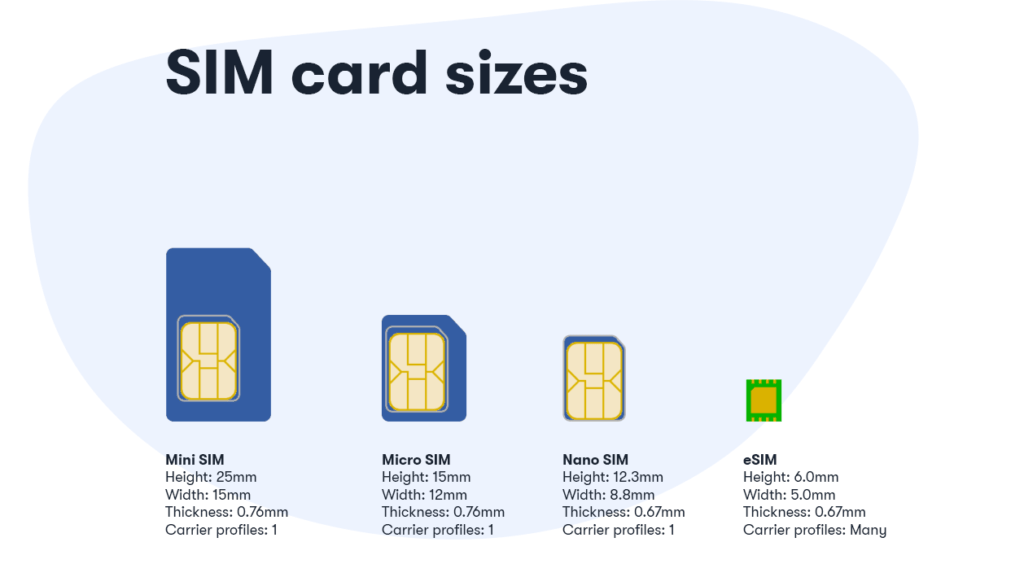
SIM cards have come a long way since their inception as large credit card-sized devices. Today, they are much smaller but just as powerful. It’s amazing to see how technology has progressed and enabled such miniaturization of these essential components while maintaining increasingly strong performance levels.
Today, we see the future of SIM cards moving towards digital versions that are smaller and more invisible. These digital SIMs offer all the same functionalities as physical SIMs, but with more capabilities.
eSIM: Software Where Hardware Used to Be
An embedded SIM, often known as an eSIM, is another example of a Digital SIM card that is taking over the smartphone industry. Especially so, now that Apple announced its new iPhone 14 lineup will only offer eSIM as the way to get connected. eSIM is a virtual duplicate of a conventional SIM card that comes already pre-installed inside your smartphone. It cannot be changed or inserted but is planted inside the device’s motherboard, removing the need to fiddle with the tiny piece of plastic. This technology also gets rid of the problems associated with switching carriers or numbers, seeming to be the solution for all those difficulties.
One of the best things about eSIMs is that they’re virtual. That means there’s no risk of wear and tear or losing data, and you don’t have to go through the hassle of ordering a new SIM and transferring all your information to it.
Furthermore, hacking eSIMs can be an uphill battle where the hacker will go through a series of security protocols that are almost impossible to bypass.
Not only do eSIMs offer the practicality of multiple profiles and subscriber data storage with unlimited space, but they can also be used abroad. That’s right – eSIMs can be utilized internationally, which means that when you travel to another country, you will not have to look for a local carrier’s SIM card to access cellular service.
Once you land in your destination country, eSIMs automatically connect with the local carrier’s network, helping you avoid an extraordinarily expensive international roaming bill.
eSIM vs. SIM Card – side by side comparison
Stacking them up side by side, it’s clear to see the differences between using a physical SIM card and an eSIM:
| Feature | Physical SIM card | eSIM |
| Locked to a carrier? | One carrier per SIM. | Reprogrammable to multiple carriers. |
| Dual-SIM (use two lines simultaneously) | Some phones have two SIM card slots. | Use an eSIM and a physical SIM, or 2 eSIMs simultaneously. |
| Switch phone lines on the fly | Pop out the SIM tray, remove the card, and pop a new one in. | Go to phone settings and turn your lines on/off. |
| Size dimensions | 12.3mm x 8.8mm | 6mm x 5mm |
Which phones support eSIMs
eSIM’s widespread adoption as the new standard has pushed nearly every phone manufacturer on the market to integrate the tech into their devices.
The first phone to support eSIM was Google’s Pixel 2, released in October 2017.
The release of the Apple iPhone XR, XS, and XS Max in 2018 increased public awareness of eSIM, as iPhones are the most popular device in the US. These were the first iPhones to support eSIM in addition to the physical card slot.
I have anecdotal experience of Apple’s stance toward eSIM based on my time working in Apple Retail.
The first time Specialists on the sales floor were instructed to default to eSIM activation was with the release of the iPhone 13. Looking back, this was a clear indicator Apple was preparing to iron out the obstacles with getting customers acclimated to eSIM technology.
Samsung, Motorola, Huawei, and many more manufacturers let you activate cellular service with eSIM. We’ve compiled a complete list of eSIM-compatible devices to help us all keep track.
eSIMs are not limited to phones.
In fact, the first-ever device to support eSIM was the Samsung Gear S2 – a 3G smartwatch! Now, eSIM is standard in wearables like the Apple Watch.
Laptops support eSIM, too! Gone are the days of lugging around a dongle or keeping track of the tiny chip that is ever so crucial to keeping you connected on the go. Acer, Dell, HP, and many more notebooks feature an eSIM that makes being productive on the road a breeze.
For Businesses and IoT
This is where eSIM really changes the game. If you manage a fleet of tablets for field workers, or connected sensors in a warehouse, or GPS trackers in delivery vehicles, eSIM lets you provision and manage connectivity remotely. No shipping SIM cards. No sending a technician to swap them. The GSMA estimates that eSIM will be the primary connectivity method for IoT devices by 2028.
- Devices with eSIM can be easily distributed and installed to connect to the right Telco automatically, based on parameters set during production.
- You may save money and improve your logistics operations by remotely managing tracker devices on worldwide shipments. This eliminates the need to replace SIM cards!
- Use eSIM to remotely update wireless plans at the end of a Telco contract to extend the life of connected devices and lower maintenance costs.
Will Physical SIM Cards Disappear?
Not overnight, but the direction is clear. Apple removed the SIM tray from US iPhones in 2022. Samsung and Google are following. The installed base of physical-SIM-only phones is still massive, so carriers will support both formats for years. But every new flagship phone released in 2025 and 2026 supports eSIM, and many are eSIM-only. Check the full list of eSIM-compatible devices to see where your phone stands.

At the same time, though, there are phones with surreal levels of hype (like the Nothing Phone (1)) that don’t support eSIM. And that’s not stopping customers from buying up all the remaining stock. So the quesion remains: will the Apple effect make waves, or will they roll it back like they did with USB-C on the MacBook?
Is installing eSIM on iPhone easy?
Your experience is going to vary vastly depending on your carrier because purchasing and activating the eSIM is completely up to how they design the experience. The uniform process of popping in a SIM card is gone now, so easy activation flow will give carriers a competitive edge. The race to make eSIM easy should benefit consumers, as the switch to eSIM is a better longterm solution than physical SIM cards.
Thankfully, US Mobile has been preparing for this massive shift in the industry, preparing the most convenient, quick, and easy-to-follow activation process. If you can navigate through a checkout screen and use the iPhone Settings app, you’ll be more than proficient!
—
As you contemplate your next big smartphone purchase, it’s worth giving some thought to the way you’ll connect to your carrier. If you want to give eSIM a shot for free, we’re offering a 10-day free trial including unlimited talk, text, and data! You’ll be glad you made the switch to eSIM once you see how convenient it is.


We activated and now in overseas and it is not working and chatting is only available when you have WiFi so we had to rental pocket WiFi which cost us extra and still chatting is not helpful. Please DO something or pay us back and give is time we lost!!! It feels scam!
It sucks!! We activated and now in overseas and it is not working and chatting is only available when you have WiFi so we had to rental pocket WiFi which cost us extra and still chatting is not helpful. Please DO something or pay us back and give is time we lost!!! It feels scam!
With the update to Android 12 Galaxy S21 varints also received esim capability. However no carriers in the US seem to support it yet
We’re expanding the list of eligible devices day by day. See the post for the most updated list of eSIM eligible devices here.
When is eSim coming to domestic plans?