

We looked at real voice, text, and data usage in the home cities of championship teams, on the night they won (or lost). Something shows up in the numbers. It’s loudest for one sport in particular.
This is a pondering, not a peer-reviewed paper. We had the usage data, we got curious, and we started pulling on a thread. The numbers are real. The stories we tell about why they happen are theories. Read them in that spirit.
Step 1: The Super Bowl lights up the winner’s city
Start with the biggest night in American sports. For the last three Super Bowls, we compared phone usage in the winning team’s home city on game day against the Sundays right before and after.
The winning city’s data usage jumps. Every time.
Chiefs win. Hometown mobile data up 19% on Super Bowl Sunday.
Eagles win. Data up 12%, and texts up a staggering 73%.
Seahawks win. Data up 9%, texts up 43%.
Three winners, three cities, three years. All light up.
Notice that the Super Bowl winner doesn’t just use more data. The texting spike is the real tell. People are not quietly streaming. They’re reaching out, all at once, to everyone they know.
Step 2: So we checked every other championship
If winning lights up a city, the effect should show up across the NBA Finals, the Stanley Cup, and the World Series too. We pulled the clinching game for each title from the last three seasons (the ones inside our data window) and measured the winning city’s mobile data on the night it clinched.
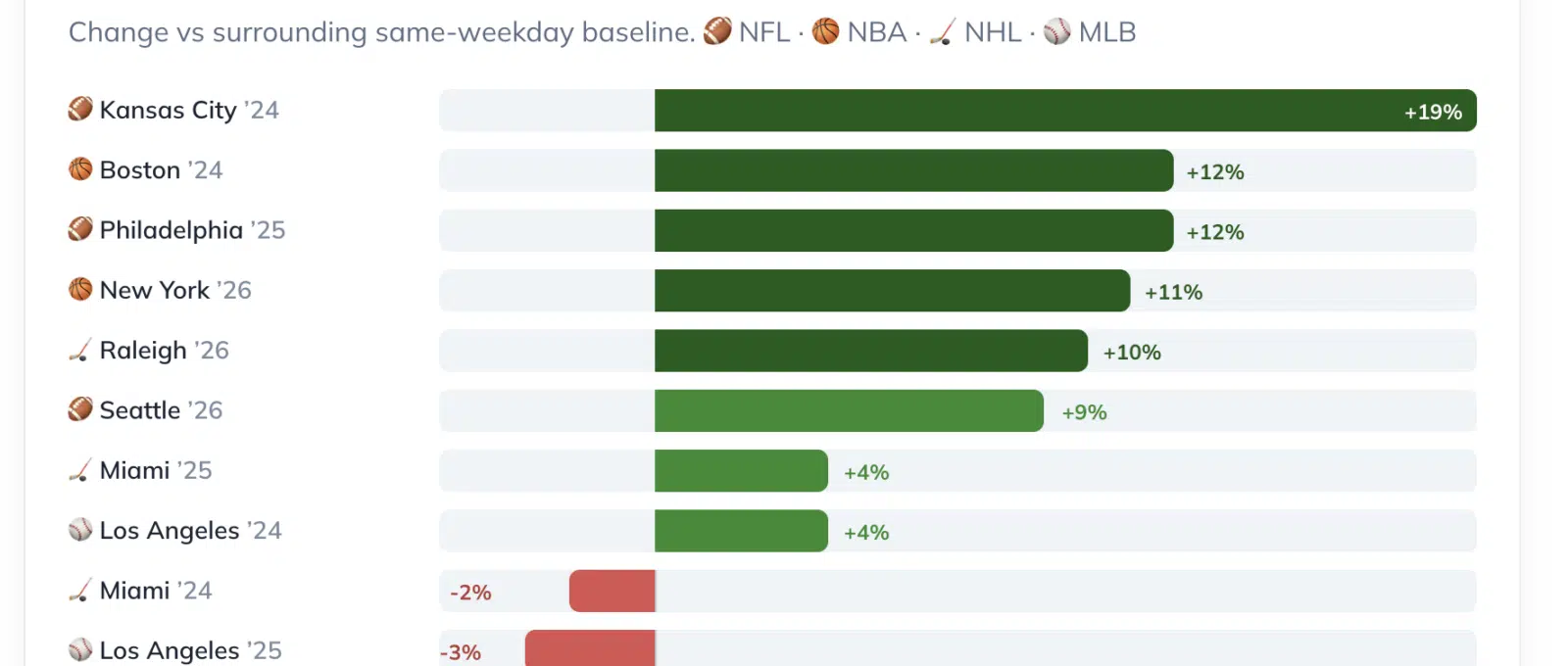
Here’s all of it, ranked by how much the winning city’s data usage rose.
The Super Bowl winners (the green 🏈 bars) cluster near the top, every single one. The other sports are scattered. Some cities lit up: Boston when the Celtics won, New York when the Knicks won, Raleigh when the Hurricanes took the Cup. Others barely flickered, and a few actually dipped.
The Super Bowl is the one game the whole country watches at the same moment. A single kickoff, a single final whistle, tens of millions of people glued to the same broadcast. When it ends, the celebration (or heartbreak) hits the phone network all at once.
A weeknight Game 5 or Game 7 in basketball, hockey, or baseball is a smaller, more scattered audience. Different start times, school nights, work the next morning. The signal is real but quieter. That’s our best guess, anyway.
Step 3: The losing city goes quiet
If winning is loud, losing is the opposite. When the Chiefs lost the 2025 Super Bowl, Kansas City’s data usage actually dropped 9% below a normal Sunday. When the Patriots lost in 2026, Boston’s data slipped too.
Same night. Same game. Two cities, twenty-one points of difference in how much their phones lit up. The mood of a city really does show up in the data.
Step 4: The host city is a ghost town (on the network)
Here’s the one that surprised us most. You’d think the city actually hosting the big game would see the biggest spike. The opposite is true.
Why would a host city’s usage fall? A theory: the people flooding into town for the game are visitors. Their phones still bill to their home cities, so they don’t show up as local. Meanwhile actual residents are either at watch parties on Wi-Fi or working the event, not burning cellular data. The host city empties out of its own signal.
Step 5: Nobody calls during the game
One last pattern, consistent across every team city we looked at. On championship night, voice calling drops while texting climbs.
In Seattle on the night the Seahawks won, voice minutes dipped 6% while texts jumped 43%. Same story in Philadelphia, in Boston, everywhere. The phone call is the wrong tool for a live event. The group chat is the right one: fast, silent, shareable, and it doesn’t make you miss the next play.
How we did this
Data source
US Mobile’s internal data warehouse. Daily voice, text, and data usage for consumer phone lines (no business or employee accounts). For each championship we took the clinching game date and compared usage in the relevant cities against the same weekday in the weeks immediately before and after.
How we picked cities
Winner and loser “cities” are the metro areas around each team’s home arena, grouped by billing city. The host city is where the deciding game was played. Some title games were won on the road, so the winner’s city and the host city are different in those cases.
What we couldn’t measure
Teams based in Canada (Toronto, Edmonton) are not part of this US dataset, so those cities are left out. A few older title games fall before voice and text were captured in our daily records, so those appear as data-only. City-level reads for smaller metros are directional rather than precise, and the day-to-day numbers carry normal noise. Treat the broad pattern as the finding, not any single percentage.
The “theories” framing
We’ve been careful to call our explanations theories. The usage numbers are what they are. Why a city behaves the way it does on a championship night is almost always a guess, and we’ve tried to flag where we’re guessing.
Cite this study
You’re welcome to reference or republish these findings with credit to US Mobile. If you build on this, we’d love to see it.
US Mobile Signal Studies. "Does Your Phone Know Your Team Won?" June 2026. usmobile.com/blog/does-your-phone-know-your-team-won

Leave a Comment