

Nearly everyone buys an unlimited plan. Almost nobody uses it like one. We looked at how much data Americans really burn through each month, and the gap is wide.
Published June 2026 · Based on anonymized US Mobile usage data · Updated annually
Key findings
Here is the short version. The person sitting right in the middle of the pack uses about 14.5 GB in a billing cycle. The average comes out higher, at 23.6 GB, and that gap is the whole story. A small band of heavy users streaming video on cellular and tethering laptops drags the average up and creates the impression that everyone needs a firehose. They do not. Half the people on these plans would never feel a 15 GB ceiling.
Why the average lies to you
When a carrier quotes the “average” data customer, hold onto your wallet. Averages get pushed around by outliers, and wireless data has plenty of them. In our data the top 10 percent of users each pulled more than 52 GB in a single month. The very top 1 percent ran past 147 GB, and one line clocked an eye-watering 658 GB. Those few accounts heave the mean up to 23.6 GB while the typical person uses far less.
The median is the honest number. It marks the point where half use more and half use less, and it shrugs off the extremes. At 14.5 GB, it shows you what normal really looks like. For a lot of households, normal is some music, a bit of maps, a steady scroll of social, and Wi-Fi quietly doing the heavy lifting at home and at work.
A handful of users eat most of the data
This is the part carriers do not put on a billboard. Data use is wildly lopsided. The top tenth of subscribers account for nearly four out of every ten gigabytes that move across the network. The bottom half, tens of thousands of real people, barely register. If you have never gotten a “you are nearing your limit” warning in your life, you already know which group you are in.
The full spread, cycle by cycle
iPhone owners use more data than Android owners
Split the same people by the phone in their pocket and a clean gap shows up. The median iPhone user runs through 15.5 GB a month. The median Android user stops at 12.5 GB. The averages land in nearly the same place, around 23 GB, which tells you the heavy hitters exist on both sides. It is the typical iPhone owner who leans on cellular a little harder, cycle after cycle.
It is not just data: the rest of the bill
While we had the numbers open, we looked at the other things a phone does. The picture rounds out the idea that most people use their plan lightly and lean on Wi-Fi.
How much data do you actually need?
Run the math on your own habits before you reach for the biggest plan on the shelf. If your phone spends most of the day on Wi-Fi, and most phones do, your cellular data is really just covering the commute, the errands, and the dead zones. For a lot of people that is a single-digit number of gigabytes.
The folks who genuinely need unlimited are real and easy to spot. They stream video over cellular instead of Wi-Fi. They tether a laptop and work from the road. They live somewhere without solid home broadband, so the phone is the internet. If that is not you, a capped plan in the 5 to 15 GB range likely covers a normal month with room left over, and usually for less money.
What plan do you actually need?
Drag the slider to roughly how much data you use in a month, then see where you land.
The map: data use is not the same everywhere
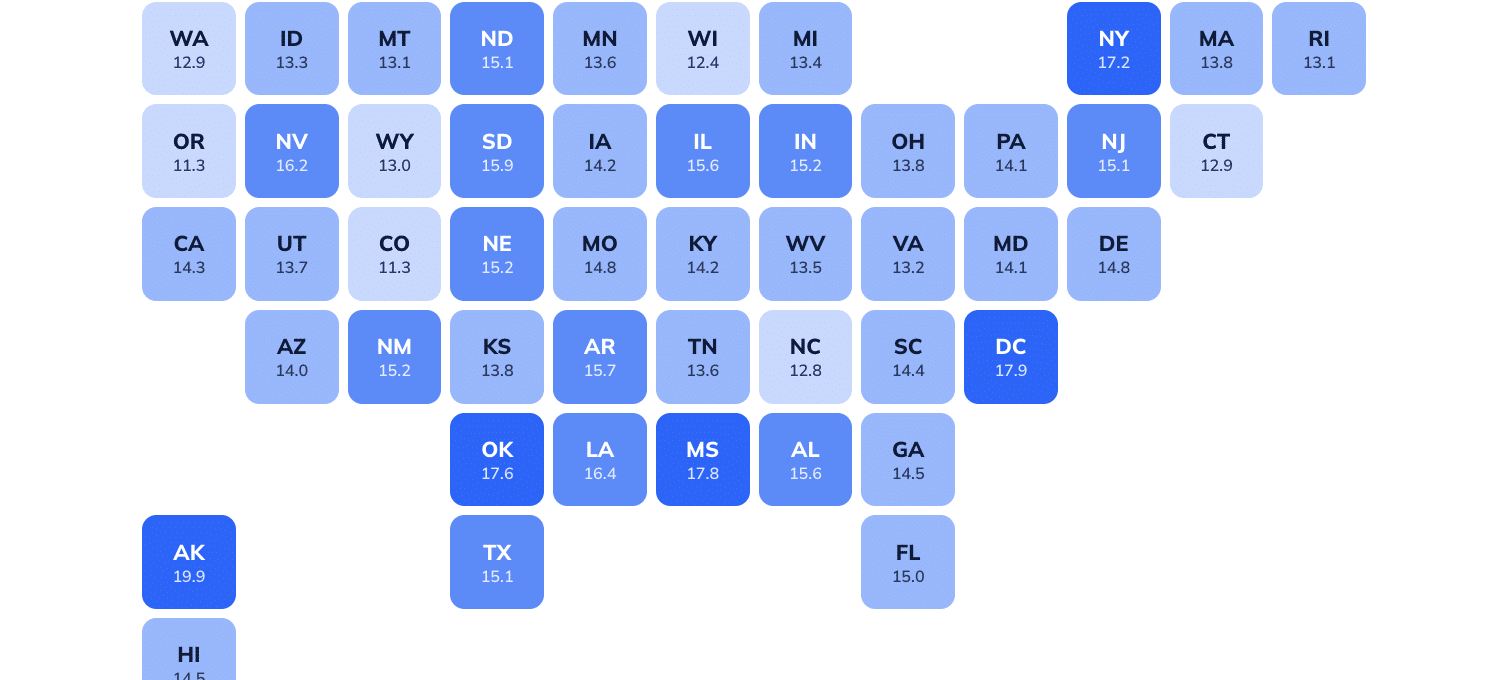
Where you live shapes the number. Heavy use clusters in the rural South and the Mountain West. Alaska tops the whole country, with Mississippi, Oklahoma, and Louisiana close behind. The lightest users sit in New England, where Vermont, Maine, and New Hampshire land at the bottom. The pattern tracks home broadband. Where wired internet is patchier, the phone picks up the slack, and the gigabytes pile on.
Median monthly data use, mapped
Each tile is a state. Darker means heavier data use. Hover any tile for the exact figure.
Here is the part that trips people up. The states at the top are not the ones you would call tech-forward. They are mostly rural and Southern: Mississippi, Oklahoma, Louisiana, Alaska. California, for all its tech, lands smack in the middle of the pack, and its usage curve is almost identical to the national one.
The reason is Wi-Fi. Cellular data is only what your phone burns when it is off Wi-Fi, so the real driver is home and office internet, not how glued to the screen anyone is. Where wired broadband is strong and offices and cafes blanket everything in signal, phones offload most of their work and sip cellular. Where home broadband is patchy and the drives are long, the phone becomes the main connection and the gigabytes climb. This map is really a broadband-access map wearing a data-usage costume.
Monthly data use by state
Search a state, filter by region, or tap any column heading to sort. Median is the typical user. Mean is the average, which the heaviest users pull upward.
| #⇅ | State⇅ | Region⇅ | Median GB⇅ | Mean GB⇅ |
|---|
A few things that surprised us
Swap a 4G phone for a 5G one and people quietly start using more data. The median 5G user runs through 15 GB a month. The median 4G user stops at 10.4 GB, about 44 percent less. Faster pipes invite heavier habits. When video loads the instant you tap it, you watch more of it.
About a third of users fire up the hotspot at some point in a month, and they are a different animal. People who tether burn a median of 23.6 GB, more than double the 11.4 GB used by people who never do. For a lot of them the phone is not just a phone, it is the home or on-the-road internet. That single habit, plugging a laptop or a TV into your phone, is one of the clearest signs that someone genuinely needs an unlimited plan.
One line in our data used 658 GB in a single month. To put that in perspective, that is like streaming high-definition video for roughly seven hours a day, every day, for thirty days straight. The typical person used 14.5 GB. This one account used about 45 times that. Somewhere out there is a phone that has never met a Wi-Fi network it liked.
How we did this
This study uses anonymized, aggregated billing data from US Mobile. We looked only at active, unlimited-plan smartphone lines, so the picture reflects how real people use a phone they rely on every day.
To keep it clean, we counted one full billing cycle per line, kept only lines that were actually in use for most of the month, and removed business accounts, employee lines, and any account flagged for fraud. We also set aside specialty plans (data-limited and filtered-phone plans, shared data pools, and backup or secondary devices), because those run low by design and are not what most readers picture as an everyday phone. Data figures cover domestic cellular usage measured in gigabytes per billing cycle.
Disclosures
Data source. First-party, anonymized usage records from US Mobile, a US wireless carrier operating on all three major networks.
Time period. Completed billing cycles observed in spring 2026 (the most recent full cycle for each line, drawn from a rolling window ending June 2026). One cycle is counted per line so longer-tenured customers are not over-weighted.
Sample. A large, nationally distributed base of active unlimited-plan smartphones across all 50 states and Washington, D.C. Every state shown reflects a robust sample, not a thin one.
Privacy. No individual customer data is shown or shared. Every number is an aggregate. Figures cannot be traced to any person or account.
Representativeness. These are US Mobile customers, not a census of every wireless user in the country. People who choose a flexible carrier may skew a little more cost-conscious than the national average, so treat the state ranking as a strong directional signal rather than an official government statistic.
Method notes. “Typical” refers to the median. “Average” refers to the mean. Percentages are rounded to one decimal place, and gigabyte figures are rounded for readability, so columns may not sum to exactly 100.
Update cadence. We plan to refresh this study every year. Figures on this page reflect the 2026 edition.
Press and data questions: [email protected]
Cite this study
You are welcome to share these findings and charts. We just ask that you credit US Mobile and link back to this page so readers can see the full methodology.
US Mobile, "The Unlimited Illusion: How Much Data Americans Actually Use" (2026). Retrieved from usmobile.com.
The takeaway
Unlimited is a comfort blanket. It is nice to know the ceiling is not there, and for a slice of heavy users it pays for itself. But the numbers are clear that most people are buying insurance against a month that never arrives. Check what you actually use, then pick the plan that fits the real you, not the worst-case you. Odds are it is smaller, and cheaper, than the one you are on.

Leave a Comment